Home › Guides › Verbal reasoning letter codes: a step-by-step guide
Verbal reasoning letter codes: a step-by-step guide
Updated 2026-11-14
Letter codes are one of the most common verbal reasoning question types. They look puzzling at first, but nearly all of them follow a few patterns, and a written alphabet makes them much easier.
Write the alphabet first
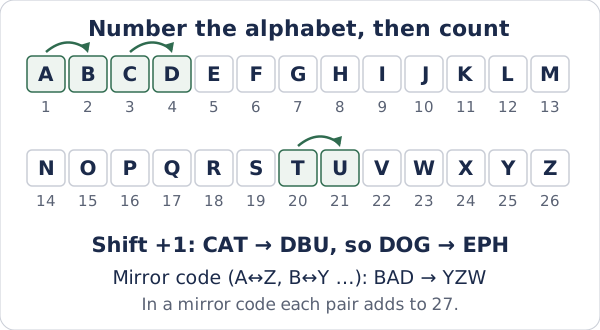
Many tests allow rough working or print the alphabet on the page. Writing A to Z across the top with the letters numbered 1 to 26 underneath turns code questions into simple counting. It is worth practising until it takes under a minute.
Type 1: every letter moves the same amount
If CAT is written as DBU, what is the code for DOG?
C to D, A to B and T to U are all one place forward. So D becomes E, O becomes P and G becomes H. The answer is EPH.
Always check every letter. Some codes move each letter by a different amount, such as +1, +2, +3.
Type 2: mirror codes
In a mirror code, each letter swaps with the letter the same distance from the other end of the alphabet: A with Z, B with Y, C with X, and so on. A quick check is that each pair adds up to 27 when you number the letters (A = 1, Z = 26).
Using a mirror code, BAD becomes YZW.
Type 3: decode a word
Some questions work backwards: given the code, find the word. Reverse the rule. If the code moves letters two places forward, move them two places back to decode. Then check that your answer is a real word, which is a good sign that the rule is right.
Practice tips
- Start untimed, writing every step, then speed up.
- Watch the ends of the alphabet: moving one place forward from Z goes back to A.
- If the first letter fits a rule but the second does not, try a different rule rather than forcing it.
Questions parents ask
Do all 11+ tests include letter codes?
No. Verbal reasoning question types vary between tests, and some tests do not include verbal reasoning at all. Check a sample paper for your child's test.
Can my child write the alphabet on the paper?
In most tests children can use rough paper or the margins, but rules vary, so check the instructions for your test.
How long should a code question take?
With practice, most children can answer a simple code question in under a minute.
Test areas mentioned
- Buckinghamshire Secondary Transfer Test: format and practice papers
- Kent Test: format and practice papers
More guides
- When should my child start preparing for the 11+?
- What is verbal reasoning in the 11+?
- What is non-verbal reasoning in the 11+?
- What maths topics are in the 11+?
- 11+ English comprehension tips for parents
- 11+ creative writing: planning, openings and timing
- 11+ standardised scores explained
- 11+ test providers explained: GL, Quest, FSCE and more
- How to use 11+ mock tests well
- A balanced Year 5 summer 11+ revision plan
- 11+ test day checklist for parents
- Keeping 11+ preparation calm and in perspective
- Grammar school vs independent school entrance tests
- Building vocabulary for the 11+
- How 11+ registration works
- The Northern Ireland transfer test: a guide for parents
- Starting 11+ preparation in Year 4: a gentle guide
- Fractions, decimals and percentages for the 11+
- How to solve 11+ maths word problems step by step
- Cloze passages in the 11+: how to fill the gaps
- Spelling strategies for the 11+ that actually stick
- Non-verbal reasoning: rotations and reflections explained
- Time management in the 11+: pacing tips for children
- Times tables for the 11+: why they matter and how to practise