Home › Guides › Non-verbal reasoning: rotations and reflections explained
Non-verbal reasoning: rotations and reflections explained
Updated 2026-11-14
Many non-verbal reasoning questions ask which shape has been turned and which has been flipped. Once children can tell a rotation from a reflection quickly, a whole group of questions becomes much easier.
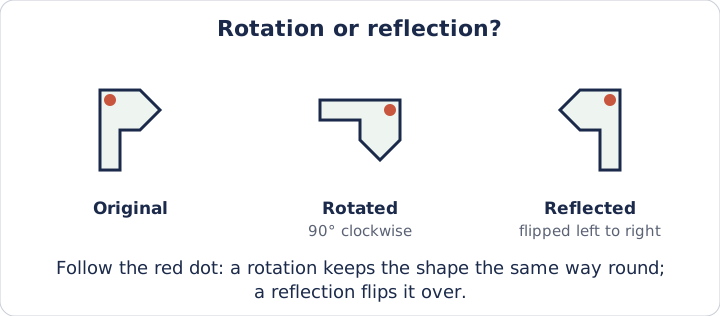
Rotation or reflection?
- A rotation turns a shape around a point, like the hands of a clock. The shape is still the same way round; it is just facing a different direction.
- A reflection flips a shape over a mirror line, like your reflection in a mirror. The shape is now the other way round.
A useful test: could you get from one shape to the other by sliding and turning it on the table? If yes, it is a rotation. If you would have to pick it up and turn it over, it is a reflection.
Simple checks
- Pick one distinctive feature, such as a small dot or a short line, and follow where it goes.
- For rotations, count the quarter turns. 90° is a quarter turn and 180° is a half turn. Check whether the question says clockwise or anticlockwise.
- For reflections, find the mirror line. Each point should be the same distance from the line on both sides.
Common traps
- Options that are reflections when the question asks for a rotation, or the other way round. These are the most common wrong answers.
- Shading or small details that have not moved with the shape. Check that details, such as which half is shaded, moved too.
- Symmetrical shapes, which look the same after some turns or flips. Use a feature that is not symmetrical.
Practising at home
Hands-on practice helps more than worksheets at first. Cut an irregular shape from card, mark one corner, and take turns rotating and flipping it. Tracing paper is excellent: trace the shape, then turn or flip the paper to test an answer.
Once your child is confident, move to timed questions on paper and encourage them to check one feature rather than the whole shape.
Questions parents ask
Is non-verbal reasoning in every 11+ test?
No. Some tests include it and some do not, so check the format of your child's test.
My child finds shapes hard. Will this improve?
Usually, yes. Spatial skills grow with practice, especially hands-on practice with card shapes, tracing paper and construction toys.
Can my child turn the paper round?
Rules vary. Children usually cannot use tracing paper in the test, so practise picturing the movement in their head as well.
Test areas mentioned
- Kent Test: format and practice papers
- Buckinghamshire Secondary Transfer Test: format and practice papers
More guides
- When should my child start preparing for the 11+?
- What is verbal reasoning in the 11+?
- What is non-verbal reasoning in the 11+?
- What maths topics are in the 11+?
- 11+ English comprehension tips for parents
- 11+ creative writing: planning, openings and timing
- 11+ standardised scores explained
- 11+ test providers explained: GL, Quest, FSCE and more
- How to use 11+ mock tests well
- A balanced Year 5 summer 11+ revision plan
- 11+ test day checklist for parents
- Keeping 11+ preparation calm and in perspective
- Grammar school vs independent school entrance tests
- Building vocabulary for the 11+
- How 11+ registration works
- The Northern Ireland transfer test: a guide for parents
- Starting 11+ preparation in Year 4: a gentle guide
- Fractions, decimals and percentages for the 11+
- How to solve 11+ maths word problems step by step
- Cloze passages in the 11+: how to fill the gaps
- Spelling strategies for the 11+ that actually stick
- Verbal reasoning letter codes: a step-by-step guide
- Time management in the 11+: pacing tips for children
- Times tables for the 11+: why they matter and how to practise