Home › Guides › Times tables for the 11+: why they matter and how to practise
Times tables for the 11+: why they matter and how to practise
Updated 2026-11-14
Quick recall of times tables underpins most of the maths in an 11+ paper, from fractions and percentages to area and ratio. A child who knows them instantly has more time and attention for the thinking part of each question.
What to aim for
In England, the National Curriculum expects children to know their times tables up to 12 × 12 by the end of Year 4, and Year 4 pupils sit a short multiplication tables check. For the 11+, the aim is instant recall, including the matching division facts: if 7 × 8 = 56, then 56 ÷ 7 = 8 and 56 ÷ 8 = 7.
It also helps to know the square numbers up to 12 × 12 = 144, and to multiply by 10, 100 and 1,000 confidently.
Five-minute ways to practise
- Quick-fire questions in the car or at breakfast, mixing the tables rather than going in order.
- Division as well as multiplication: “What times 6 makes 42?”
- A pack of cards: take out the kings, turn over two cards and multiply them (count jacks as 11 and queens as 12).
- Beat your score: one minute of mixed questions, recorded on a chart.
- Free online flash cards, such as the maths cards on our website.
Focus on the tricky ones
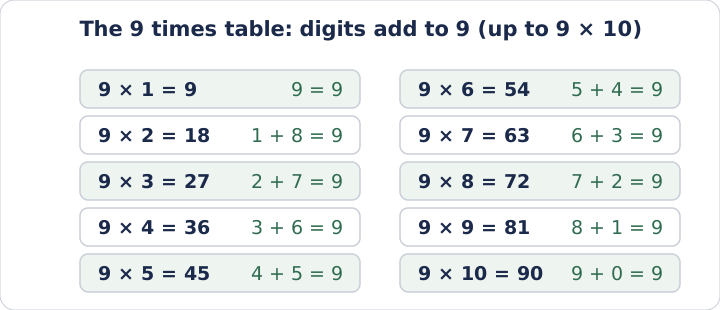
Many children find a small group of facts hard, often the 6, 7, 8 and 12 times tables. Keep a list of the facts your child hesitates on and spend most practice time there. Patterns help: up to 9 × 10, the digits of the 9 times table add to 9 (9 × 7 = 63, and 6 + 3 = 9), and the 12 times table is 10 times plus 2 times.
Using tables in 11+ questions
Times tables are rarely tested on their own in the 11+. They appear inside other questions: simplifying 24/36, finding 3/8 of 64, working out the area of a 7 cm by 9 cm rectangle, or sharing in a ratio. Once recall is quick, show your child how often these facts come up in practice papers.
Questions parents ask
My child is in Year 5 and still unsure of some tables. Is it too late?
Not at all. Ten minutes a day on the facts they don't know will make a big difference within a few weeks.
Should my child use tricks or just memorise?
Both. Patterns help with understanding, but the aim is instant recall without needing the trick.
Are times tables enough for 11+ maths?
They are the foundation, but children also need to apply them to fractions, area, ratio and word problems.
More guides
- When should my child start preparing for the 11+?
- What is verbal reasoning in the 11+?
- What is non-verbal reasoning in the 11+?
- What maths topics are in the 11+?
- 11+ English comprehension tips for parents
- 11+ creative writing: planning, openings and timing
- 11+ standardised scores explained
- 11+ test providers explained: GL, Quest, FSCE and more
- How to use 11+ mock tests well
- A balanced Year 5 summer 11+ revision plan
- 11+ test day checklist for parents
- Keeping 11+ preparation calm and in perspective
- Grammar school vs independent school entrance tests
- Building vocabulary for the 11+
- How 11+ registration works
- The Northern Ireland transfer test: a guide for parents
- Starting 11+ preparation in Year 4: a gentle guide
- Fractions, decimals and percentages for the 11+
- How to solve 11+ maths word problems step by step
- Cloze passages in the 11+: how to fill the gaps
- Spelling strategies for the 11+ that actually stick
- Verbal reasoning letter codes: a step-by-step guide
- Non-verbal reasoning: rotations and reflections explained
- Time management in the 11+: pacing tips for children