Home › Guides › Fractions, decimals and percentages for the 11+
Fractions, decimals and percentages for the 11+
Updated 2026-11-14
Fractions, decimals and percentages turn up in almost every 11+ maths paper, often hidden inside a word problem. The good news is that they are three ways of writing the same idea, and a few facts make them much easier.
Three ways to say the same amount
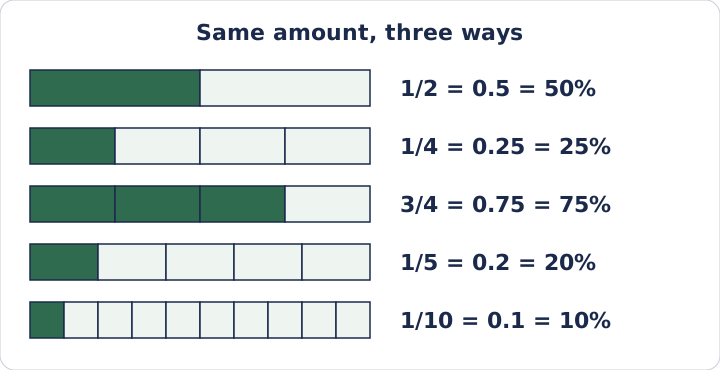
A half, 0.5 and 50% are the same amount written in three ways. Children who can move easily between the three forms find many questions quicker, because they can pick whichever form makes the sum simplest.
It helps to know these equivalents by heart:
- 1/2 = 0.5 = 50%
- 1/4 = 0.25 = 25% and 3/4 = 0.75 = 75%
- 1/5 = 0.2 = 20% and 1/10 = 0.1 = 10%
- 1/8 = 0.125 = 12.5%
- 1/3 is about 0.333, or 33⅓%
Quick methods worth practising
- Finding 10%: divide by 10. Then 5% is half of that, and 20% is double it. For example, 15% of 60 is 6 + 3 = 9.
- Finding a fraction of an amount: divide by the bottom number, multiply by the top. 3/5 of 40 is 40 ÷ 5 × 3 = 24.
- Comparing fractions: turn them into decimals or give them the same denominator. Which is bigger, 3/5 or 5/8? 0.6 against 0.625, so 5/8.
- Simplifying: divide the top and bottom by the same number. 12/18 becomes 2/3 when you divide both by 6.
The mistakes children make most often
- Thinking a bigger denominator means a bigger fraction. 1/8 is smaller than 1/6, because the whole is cut into more pieces.
- Adding fractions by adding the tops and the bottoms. 1/2 + 1/4 is 3/4, not 2/6.
- Lining up decimals by the last digit instead of the decimal point when adding or subtracting.
- Forgetting what the question asks for: the percentage that is left, or the percentage that was taken away.
A five-minute routine
Little and often works best. Two or three times a week, ask five quick questions: one equivalent, one percentage of an amount, one fraction of an amount, one comparison and one short word problem. Mark them together and talk about any method that went wrong.
Pizza, cake and money are useful at home. Ask what fraction of the pizza is left, or what a 20% discount would take off a price in a shop.
Questions parents ask
Which year are fractions, decimals and percentages taught?
They build up through Key Stage 2. Most of what the 11+ asks for is taught by the end of Year 5, with some extension work in Year 6, so check the topics with your child's school if you are unsure.
Are calculators allowed in the 11+?
No calculator is allowed in the 11+ tests we know of, so mental and written methods matter. Check the rules for your child's test.
What should my child learn by heart?
The common equivalents (halves, quarters, fifths, tenths and eighths) and how to find 10% and 1% of an amount. Most other questions build on these.
More guides
- When should my child start preparing for the 11+?
- What is verbal reasoning in the 11+?
- What is non-verbal reasoning in the 11+?
- What maths topics are in the 11+?
- 11+ English comprehension tips for parents
- 11+ creative writing: planning, openings and timing
- 11+ standardised scores explained
- 11+ test providers explained: GL, Quest, FSCE and more
- How to use 11+ mock tests well
- A balanced Year 5 summer 11+ revision plan
- 11+ test day checklist for parents
- Keeping 11+ preparation calm and in perspective
- Grammar school vs independent school entrance tests
- Building vocabulary for the 11+
- How 11+ registration works
- The Northern Ireland transfer test: a guide for parents
- Starting 11+ preparation in Year 4: a gentle guide
- How to solve 11+ maths word problems step by step
- Cloze passages in the 11+: how to fill the gaps
- Spelling strategies for the 11+ that actually stick
- Verbal reasoning letter codes: a step-by-step guide
- Non-verbal reasoning: rotations and reflections explained
- Time management in the 11+: pacing tips for children
- Times tables for the 11+: why they matter and how to practise