Home › Guides › Cloze passages in the 11+: how to fill the gaps
Cloze passages in the 11+: how to fill the gaps
Updated 2026-11-14
A cloze passage is a piece of text with words, or parts of words, missing. Many 11+ English and verbal reasoning papers use them, because they test reading, vocabulary, grammar and spelling all at once.
The main types
- Choose a word: pick the best word for each gap from a list of options.
- Missing letters: some letters of a word are given and the child fills in the rest.
- Word bank: choose words for several gaps from a shared list, using each word once.
Look at a sample paper for your child's test to see which kind it uses, as the format varies between tests.
A method that works
- Read the whole passage quickly first, to understand what it is about.
- For each gap, read the full sentence, and the sentence after it if needed.
- Ask what kind of word fits: a noun, a verb, an adjective? Singular or plural? Past or present?
- Try your choice in the sentence and read it again in your head. Does it sound right and make sense?
- With a word bank, cross off words as you use them and leave the hardest gaps until last.
A short example
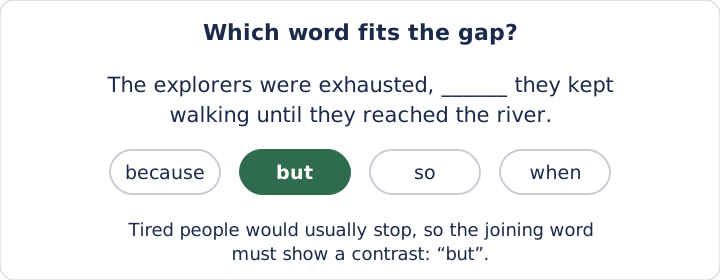
“The explorers were exhausted, ______ they kept walking until they reached the river.” Options: because, but, so, when.
The second half of the sentence goes against what we would expect from tired people, so the joining word must show contrast. The answer is “but”.
Building the skills behind it
Cloze questions reward wide reading more than any trick. Children who read often have a feel for how sentences flow and which words go together. Talking about new words, playing word games and reading a mix of stories and non-fiction all help.
For missing-letter questions, spelling patterns and prefixes and suffixes matter, so short spelling practice pays off here too.
Questions parents ask
Is cloze English or verbal reasoning?
It can be either. Some tests put cloze passages in the English section and others in verbal reasoning. Check a sample paper for your child's test.
What if two words seem to fit?
Read the sentences either side. The wider meaning, tense or grammar usually rules one out.
How can we practise at home?
Cover a few words in a newspaper article or a page of a book and guess them together, then compare with the original.
More guides
- When should my child start preparing for the 11+?
- What is verbal reasoning in the 11+?
- What is non-verbal reasoning in the 11+?
- What maths topics are in the 11+?
- 11+ English comprehension tips for parents
- 11+ creative writing: planning, openings and timing
- 11+ standardised scores explained
- 11+ test providers explained: GL, Quest, FSCE and more
- How to use 11+ mock tests well
- A balanced Year 5 summer 11+ revision plan
- 11+ test day checklist for parents
- Keeping 11+ preparation calm and in perspective
- Grammar school vs independent school entrance tests
- Building vocabulary for the 11+
- How 11+ registration works
- The Northern Ireland transfer test: a guide for parents
- Starting 11+ preparation in Year 4: a gentle guide
- Fractions, decimals and percentages for the 11+
- How to solve 11+ maths word problems step by step
- Spelling strategies for the 11+ that actually stick
- Verbal reasoning letter codes: a step-by-step guide
- Non-verbal reasoning: rotations and reflections explained
- Time management in the 11+: pacing tips for children
- Times tables for the 11+: why they matter and how to practise