Home › Guides › How to solve 11+ maths word problems step by step
How to solve 11+ maths word problems step by step
Updated 2026-11-14
Many children can do the sums but lose marks on word problems, because the maths is wrapped in a story. A simple routine helps them unwrap it calmly.
Why word problems feel hard
A word problem asks a child to do two jobs: understand the situation, then do the maths. Under time pressure it is easy to grab the numbers and do the first sum that comes to mind. Many mistakes happen in the reading, not the arithmetic.
A five-step routine
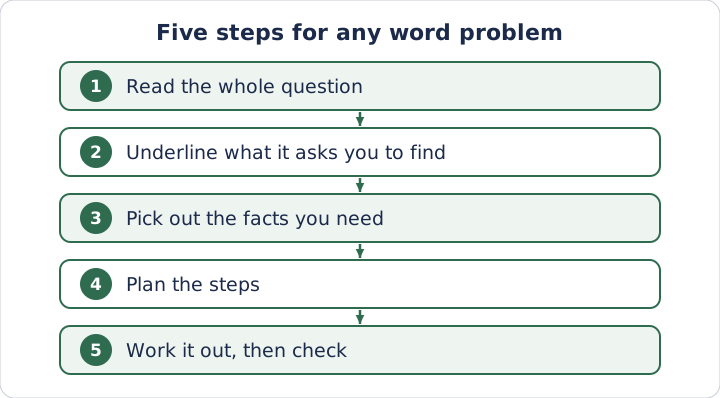
- Read the whole question once, all the way to the end.
- Find the actual question: underline what you are asked to find, such as “how much change” or “how many more”.
- Pick out the useful information. Some questions include numbers you do not need.
- Plan the steps: which operation comes first, and is there more than one step?
- Work it out, then check that the answer makes sense and has the right units.
A worked example
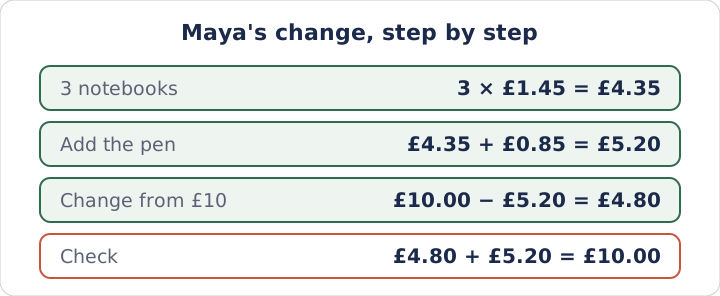
Question: Maya buys 3 notebooks at £1.45 each and a pen for 85p. She pays with a £10 note. How much change does she get?
- The question is “how much change”, so the last step will be a subtraction from £10.
- Notebooks: 3 × £1.45 = £4.35.
- Total spent: £4.35 + £0.85 = £5.20.
- Change: £10.00 − £5.20 = £4.80.
- Check: £4.80 + £5.20 = £10.00, so the answer makes sense.
Common traps
- Mixing units, such as pence and pounds, or minutes and hours. Change everything to the same unit first.
- Answering a different question, for example giving the total spent instead of the change.
- Stopping after the first step of a two-step problem.
- Key words can mislead: “more” does not always mean add. Think about what is actually happening.
In multiple-choice papers, the wrong options are often the answers you get from these slips. That is why checking is worth the few seconds it takes.
Questions parents ask
Should my child write down their working?
Yes. Even in multiple-choice tests, jotting the steps on rough paper reduces slips. In written-answer papers, there may be marks for the method too.
How can I help if maths isn't my strength?
Ask your child to explain each step to you out loud. Explaining a method is one of the best ways to learn it, and you don't need to know the answer to listen.
How many word problems should we practise?
A few each session is plenty. Talking through one problem well is worth more than rushing through ten.
More guides
- When should my child start preparing for the 11+?
- What is verbal reasoning in the 11+?
- What is non-verbal reasoning in the 11+?
- What maths topics are in the 11+?
- 11+ English comprehension tips for parents
- 11+ creative writing: planning, openings and timing
- 11+ standardised scores explained
- 11+ test providers explained: GL, Quest, FSCE and more
- How to use 11+ mock tests well
- A balanced Year 5 summer 11+ revision plan
- 11+ test day checklist for parents
- Keeping 11+ preparation calm and in perspective
- Grammar school vs independent school entrance tests
- Building vocabulary for the 11+
- How 11+ registration works
- The Northern Ireland transfer test: a guide for parents
- Starting 11+ preparation in Year 4: a gentle guide
- Fractions, decimals and percentages for the 11+
- Cloze passages in the 11+: how to fill the gaps
- Spelling strategies for the 11+ that actually stick
- Verbal reasoning letter codes: a step-by-step guide
- Non-verbal reasoning: rotations and reflections explained
- Time management in the 11+: pacing tips for children
- Times tables for the 11+: why they matter and how to practise