Home › Guides › Time management in the 11+: pacing tips for children
Time management in the 11+: pacing tips for children
Updated 2026-11-14
Many children know enough to do well but run out of time. Pacing is a skill of its own, and it can be practised in short, calm steps.
Work out the pace
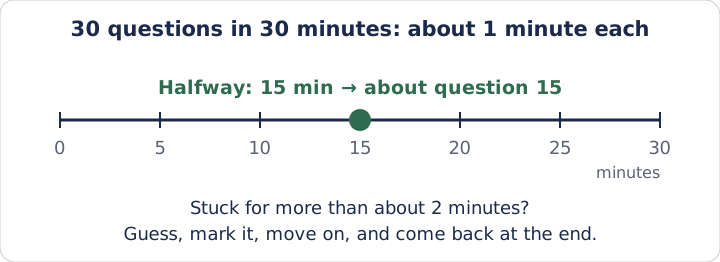
Divide the time by the number of questions to find a rough time per question. If a section has 30 questions in 30 minutes, that is about a minute each. Some questions will take 20 seconds and others two minutes; the average is what matters.
A simple checkpoint helps: halfway through the time, your child should be about halfway through the questions.
Move on, then come back
The biggest time-waster is getting stuck. Teach a simple rule: if a question has taken more than about twice the average time, mark it, make a sensible guess, and move on. Come back to it at the end if there is time.
Every question usually carries the same mark, so an easy question at the end is worth as much as a hard one in the middle.
Answer every question
In most multiple-choice 11+ tests there is no penalty for a wrong answer, so a sensible guess is better than a blank. Rule out any options that are clearly wrong first. Check the instructions for your child's test, in case it works differently.
Practise in stages
- First, practise untimed to build accuracy and confidence.
- Next, time short sets of 10 questions and note how long they take.
- Then sit a full section with a visible clock, using the halfway checkpoint.
- Finally, try a full mock paper in test-like conditions, a few weeks before the test.
After each timed practice, talk about where the time went rather than only the score. Small changes, such as reading the question before the options, add up.
Questions parents ask
My child rushes and makes careless mistakes. What helps?
Practise accuracy untimed first, then add timing gradually. A quick check of each answer against the question usually saves more marks than it costs in time.
Should my child wear a watch?
There is usually a clock in the test room, but rules on watches vary. Check the instructions you are sent before the test.
How much timed practice is enough?
A few timed sections a week in the last couple of months is plenty for most children. Full papers are best kept for the final few weeks.
More guides
- When should my child start preparing for the 11+?
- What is verbal reasoning in the 11+?
- What is non-verbal reasoning in the 11+?
- What maths topics are in the 11+?
- 11+ English comprehension tips for parents
- 11+ creative writing: planning, openings and timing
- 11+ standardised scores explained
- 11+ test providers explained: GL, Quest, FSCE and more
- How to use 11+ mock tests well
- A balanced Year 5 summer 11+ revision plan
- 11+ test day checklist for parents
- Keeping 11+ preparation calm and in perspective
- Grammar school vs independent school entrance tests
- Building vocabulary for the 11+
- How 11+ registration works
- The Northern Ireland transfer test: a guide for parents
- Starting 11+ preparation in Year 4: a gentle guide
- Fractions, decimals and percentages for the 11+
- How to solve 11+ maths word problems step by step
- Cloze passages in the 11+: how to fill the gaps
- Spelling strategies for the 11+ that actually stick
- Verbal reasoning letter codes: a step-by-step guide
- Non-verbal reasoning: rotations and reflections explained
- Times tables for the 11+: why they matter and how to practise