Home › Guides › Spelling strategies for the 11+ that actually stick
Spelling strategies for the 11+ that actually stick
Updated 2026-11-14
Spelling appears in many 11+ papers, either directly in spot-the-mistake questions or indirectly in cloze passages and written answers. Long lists learned for a Friday test are often forgotten by Monday, so it helps to use methods that last.
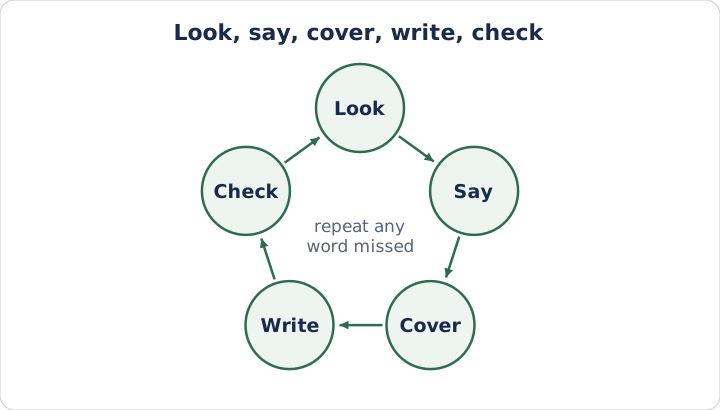
Look, say, cover, write, check
This simple routine is still one of the best. Look at the word, say it carefully, cover it, write it from memory, then check it. Repeat for any word that went wrong. Saying the word in syllables, such as “in-ter-est-ing”, helps with long words.
Learn patterns, not just lists
- Word families: if you can spell “sign”, you can spell “signal” and “signature”, and the silent “g” makes sense.
- Prefixes: un-, dis-, mis-, re- and pre- are added without changing the root word, so “misspell” has two s's.
- Suffixes: learn the rules for -ing, -ed and -ly, such as doubling the last consonant in “running” and keeping the “e” in “lovely”.
- Tricky endings: -tion, -sion, -cian, -ous and -ible or -able come up often in 11+ papers.
Memory tricks for the awkward ones
Some words do not follow the rules, and a memorable trick can fix them for good. Children remember tricks they invent themselves best. For example:
- “Necessary”: one collar and two sleeves (one c, two s's).
- “Separate”: there is “a rat” in separate.
- “Because”: big elephants can always understand small elephants.
A simple weekly routine
Choose eight to ten words a week: some from your child's own writing, some from a pattern you are working on. Practise for five minutes on three or four days, then test them in sentences at the end of the week. Return to any that went wrong a fortnight later, because coming back to a word after a gap helps it stick.
Keep a small notebook of “my tricky words”. Seeing the list shrink is motivating.
Questions parents ask
Which words should my child learn?
Start with the Year 3–4 and Year 5–6 statutory spelling lists in the National Curriculum for England, which your child's school can share, then add words from their own reading and writing.
How are spellings tested in the 11+?
It varies. Some papers ask children to find the misspelt word in a sentence or passage; others test spelling through missing letters or in a writing task. Check a sample paper for your test.
Does handwriting matter?
In written answers, a word that cannot be read may not get the mark, so clear, joined handwriting helps.
More guides
- When should my child start preparing for the 11+?
- What is verbal reasoning in the 11+?
- What is non-verbal reasoning in the 11+?
- What maths topics are in the 11+?
- 11+ English comprehension tips for parents
- 11+ creative writing: planning, openings and timing
- 11+ standardised scores explained
- 11+ test providers explained: GL, Quest, FSCE and more
- How to use 11+ mock tests well
- A balanced Year 5 summer 11+ revision plan
- 11+ test day checklist for parents
- Keeping 11+ preparation calm and in perspective
- Grammar school vs independent school entrance tests
- Building vocabulary for the 11+
- How 11+ registration works
- The Northern Ireland transfer test: a guide for parents
- Starting 11+ preparation in Year 4: a gentle guide
- Fractions, decimals and percentages for the 11+
- How to solve 11+ maths word problems step by step
- Cloze passages in the 11+: how to fill the gaps
- Verbal reasoning letter codes: a step-by-step guide
- Non-verbal reasoning: rotations and reflections explained
- Time management in the 11+: pacing tips for children
- Times tables for the 11+: why they matter and how to practise